
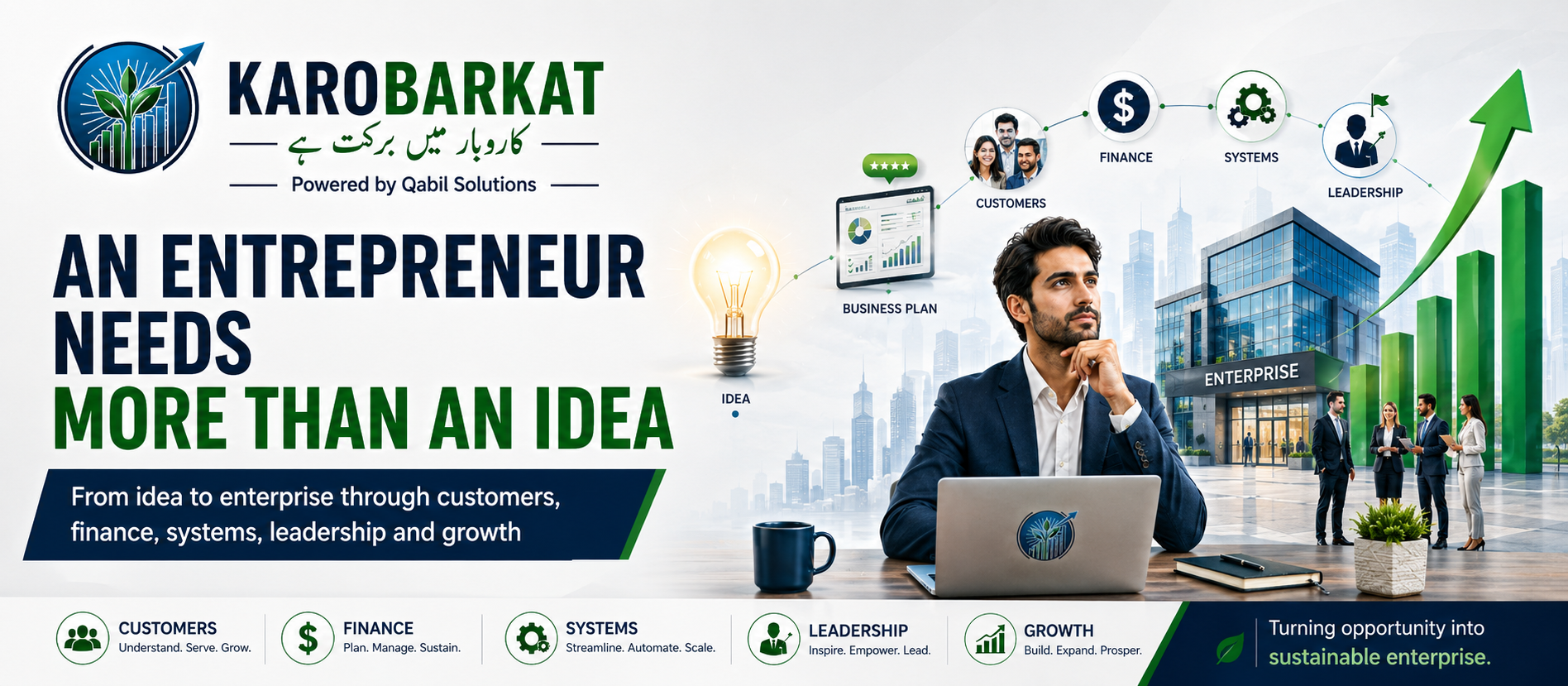
An Idea Is Only the Beginning
Many businesses begin with a moment of inspiration.
Someone notices a problem.
Someone sees an unmet need.
Someone discovers a better way to deliver a product or service.
And suddenly there is an idea.
That idea matters.
Without ideas, there would be no new businesses, products, services or industries.
But one of the most important lessons an aspiring entrepreneur can learn is this:
A good idea is not the same thing as a good business.
An idea may identify an opportunity.
A business must turn that opportunity into something customers are willing to pay for — repeatedly, profitably and sustainably.
That requires far more than creativity.
It requires execution, financial understanding, systems, discipline, leadership and constant learning.
This is why Karobarkat believes that entrepreneurship education should not focus merely on encouraging people to “start something.”
We need to teach people how businesses are actually built.
Ideas Are Easy to Admire. Execution Is Harder.
Entrepreneurs naturally become emotionally attached to their ideas.
They may spend months thinking about a product, service, platform or concept.
They imagine the market opportunity.
They imagine customers.
They imagine growth.
Sometimes they imagine the company becoming successful before the first customer has even paid them.
But businesses do not succeed because their founders are excited about them.
They succeed when customers find enough value in what they offer to exchange their money for it.
And then continue doing so.
This means entrepreneurship requires moving beyond:
“I have a great idea.”
towards:
“I understand exactly how this idea becomes a viable business.”
That second question is considerably harder.
Start With the Customer, Not the Product
An entrepreneur may love a product.
The market does not care.
The market cares about whether that product solves a problem, satisfies a need, saves time, reduces cost, improves convenience, creates status, provides entertainment or produces some other form of value.
This is why one of the first questions every entrepreneur should ask is:
Who exactly am I solving a problem for?
Not:
“Everyone.”
Not:
“Anyone who needs it.”
But a clearly understood customer.
Who are they?
What problem do they have?
How serious is that problem?
How are they solving it today?
What frustrates them about existing alternatives?
What would make them switch?
How much are they willing to pay?
Where do they make purchasing decisions?
The better an entrepreneur understands the customer, the better the business can become.
A business without customer understanding is often little more than an assumption.
A Product Is Not a Business Model
Another common mistake is confusing the product with the business.
A product answers:
What are we selling?
A business model answers:
How does the entire business work economically?
For example:
Who pays us?
How much do they pay?
How often?
What does it cost us to serve them?
What margins do we generate?
Do customers purchase once or repeatedly?
How much does it cost to acquire a customer?
How long does the customer remain with us?
What infrastructure do we need?
How much working capital is required?
What prevents competitors from copying us?
These questions determine whether an idea can become commercially sustainable.
You can have an excellent product and still have a poor business model.
You can have enthusiastic customers and still lose money.
You can have strong demand and still fail because you cannot deliver efficiently.
A serious entrepreneur therefore needs to understand not only the product, but the economics around the product.
Sales Are Not Something You Think About Later
Many new entrepreneurs spend enormous amounts of time developing:
- logos,
- websites,
- packaging,
- social media pages,
- office interiors,
- business cards,
- applications,
- and presentations.
But very little time answering the question:
How will we actually acquire customers?
Sales are not the final stage of entrepreneurship.
Sales are part of the business from the beginning.
A company needs to know:
Where will leads come from?
How will prospects discover us?
Who will speak to them?
What objections will they have?
Why should they trust us?
How long will the sales process take?
What percentage will convert?
How much will it cost to generate each sale?
How will customers buy again?
A business that cannot consistently generate customers does not have a branding problem.
It has a business problem.
Marketing Is More Than Promotion
Marketing is often misunderstood as advertising.
It is much broader.
Marketing includes understanding:
- the customer,
- the market,
- competitors,
- positioning,
- pricing,
- distribution,
- messaging,
- customer experience,
- and brand perception.
Advertising is only one way of communicating with the market.
Strong marketing begins much earlier.
It asks:
Why should the customer choose us instead of somebody else?
If an entrepreneur cannot answer that clearly, spending more on advertising may simply make more people aware of an unclear proposition.
Marketing should create clarity.
Sales should convert that clarity into revenue.
Revenue Is Not Profit
This is one of the most important lessons in business.
Revenue is not profit.
A company may generate Rs. 100 million in sales and still lose money.
Why?
Because revenue is only the money earned from selling goods or services.
From that revenue, the business may still need to pay:
- cost of goods,
- salaries,
- rent,
- electricity,
- marketing,
- technology,
- logistics,
- taxes,
- financing costs,
- repairs,
- administration,
- and numerous other expenses.
Revenue can make a business look impressive.
Profit tells us whether the underlying economics are working.
An entrepreneur who celebrates sales without understanding margins may be growing a business that becomes more financially fragile as it becomes larger.
Profit Is Not Cash Flow
There is another distinction every entrepreneur must understand:
Profit is not cash flow.
A business can be profitable on paper and still run out of cash.
Consider a company that sells Rs. 10 million worth of products to customers on 90-day credit.
The sale may be recorded immediately.
The profit may also appear in the accounts.
But the cash may not arrive for three months.
Meanwhile, the company still has to pay employees, suppliers, rent and operating expenses.
This is how profitable businesses can experience serious cash-flow problems.
Growing businesses are particularly vulnerable because growth often requires more money tied up in:
- inventory,
- receivables,
- staff,
- production,
- expansion,
- and infrastructure.
This is why every entrepreneur should learn to read and understand cash flow, not simply profit.
Growth Is Not Automatically Success
Growth sounds positive.
More customers.
More revenue.
More employees.
More locations.
More products.
More markets.
But growth can destroy a business if it is poorly managed.
Suppose a company doubles its sales.
That sounds excellent.
But what if:
- margins fall,
- customer complaints increase,
- receivables become unmanageable,
- inventory grows too quickly,
- employees are poorly trained,
- quality deteriorates,
- borrowing increases,
- or the founder loses operational control?
Then revenue growth may actually increase the company's risk.
The correct question is not only:
“Are we growing?”
It is:
“Are we growing in a financially and operationally healthy way?”
Sustainable growth requires systems.
Operations Turn Promises Into Reality
Marketing may convince a customer.
Sales may close the deal.
Operations must deliver what was promised.
This includes:
- procurement,
- production,
- inventory,
- quality control,
- customer service,
- logistics,
- processes,
- technology,
- reporting,
- and internal coordination.
A business becomes stronger when the customer experience does not depend entirely on the founder personally managing every detail.
That requires repeatable systems.
Good entrepreneurs eventually learn that their job is not simply to do the work.
Their job is increasingly to build the system through which the work gets done.
The Founder Cannot Remain the Entire Business
Many small businesses begin with one highly capable founder.
The founder sells.
The founder purchases.
The founder approves payments.
The founder handles customers.
The founder solves employee problems.
The founder monitors operations.
The founder knows everything.
Initially, this may be necessary.
But eventually it becomes a constraint.
If every important decision requires one person, the business cannot truly scale.
The entrepreneur therefore needs to move from being:
the person who runs everything
towards becoming:
the person who builds an organisation capable of running well.
That requires delegation.
It requires processes.
It requires reporting.
It requires competent managers.
And most importantly, it requires trust supported by accountability.
People Can Strengthen or Destroy a Business
Every business eventually becomes a people business.
Even highly automated companies rely on people to:
- make decisions,
- sell,
- design,
- operate systems,
- solve problems,
- manage customers,
- innovate,
- and lead.
Hiring the wrong people can damage a growing company quickly.
Hiring the right people but managing them poorly can have the same effect.
Entrepreneurs therefore need to learn:
How to hire.
How to define roles.
How to set expectations.
How to measure performance.
How to provide feedback.
How to reward contribution.
How to resolve conflict.
How to develop future leaders.
A great founder with a weak team eventually becomes a bottleneck.
A strong organisation develops capability beyond the founder.
Leadership Is Different From Ownership
Owning a business does not automatically make someone an effective leader.
Leadership requires:
- clarity,
- communication,
- decision-making,
- discipline,
- accountability,
- emotional maturity,
- and the ability to create direction during uncertainty.
Employees watch what founders do more closely than what founders say.
If the founder is careless with money, employees learn that financial discipline does not matter.
If the founder regularly breaks processes, employees learn that processes are optional.
If the founder avoids difficult decisions, problems remain unresolved.
Culture is therefore not simply something written on an office wall.
It is created by repeated behaviour.
Entrepreneurs Must Understand Their Numbers
One of the biggest weaknesses in many small businesses is that founders know their products extremely well but know surprisingly little about their numbers.
Every serious entrepreneur should understand at least the fundamentals of:
- revenue,
- gross profit,
- gross margin,
- operating expenses,
- net profit,
- cash flow,
- accounts receivable,
- accounts payable,
- inventory,
- debt,
- working capital,
- break-even,
- and return on investment.
This does not mean every entrepreneur needs to become an accountant.
It means they should understand enough financial information to make intelligent decisions.
A founder who does not understand the company's numbers is effectively running part of the business in the dark.
Pricing Can Determine Whether the Business Survives
Pricing is another area where entrepreneurs frequently make decisions based on instinct.
Some price too low because they fear customers will leave.
Some copy competitors.
Some add an arbitrary percentage to cost.
Some price based on what feels reasonable.
But pricing affects:
- margins,
- positioning,
- customer perception,
- working capital,
- growth,
- and profitability.
A business can sell a lot and still fail because it is selling at the wrong price.
Entrepreneurs must therefore understand their costs, market position and customer value before determining pricing.
Sometimes increasing sales is not the answer.
Sometimes improving the economics of each sale matters more.
Strategy Means Choosing What Not to Do
Entrepreneurs naturally see opportunities everywhere.
A new product.
Another city.
A new customer segment.
A partnership.
Another service.
An export market.
A franchise.
A mobile application.
But pursuing every opportunity can weaken the company.
Strategy is not simply deciding what the company wants to do.
Strategy also means deciding what the company will deliberately not do.
Resources are limited.
Capital is limited.
Management attention is limited.
Time is limited.
Strong businesses allocate these resources deliberately.
That requires focus.
Governance Matters Before the Business Becomes Large
Governance is sometimes treated as something only large corporations require.
That is a mistake.
Even smaller companies benefit from clarity around:
- ownership,
- authority,
- financial controls,
- approvals,
- responsibilities,
- reporting,
- shareholder rights,
- conflicts of interest,
- and decision-making.
Governance becomes particularly important when:
- there are multiple founders,
- family members are involved,
- investors enter the business,
- significant capital is being deployed,
- or the company begins growing rapidly.
Problems that feel manageable when the company is small can become extremely damaging later.
Good governance should not begin after trust disappears.
It should help protect trust from the beginning.
Capital Does Not Fix a Weak Business
Entrepreneurs frequently assume that funding will solve their problems.
Sometimes it does.
A capable business may genuinely require capital to increase capacity, expand distribution or enter new markets.
But capital does not automatically fix:
- poor pricing,
- weak demand,
- bad management,
- poor margins,
- ineffective marketing,
- operational disorder,
- or lack of strategic direction.
In fact, additional capital can allow a weak business to lose money faster.
Before asking:
“How do I raise investment?”
an entrepreneur should first ask:
“Have I built something worth investing in?”
Investor readiness begins with business readiness.
Investors Need Information, Not Only Enthusiasm
Entrepreneurs often become frustrated when investors ask difficult questions.
But serious investors should ask difficult questions.
They want to understand:
- how the business makes money,
- historical financial performance,
- growth assumptions,
- risks,
- competition,
- customer concentration,
- capital requirements,
- governance,
- ownership,
- and how their investment may eventually generate a return.
A founder should therefore learn how to communicate the business professionally.
An investment pitch should not merely communicate excitement.
It should communicate understanding.
Entrepreneurship Requires Continuous Learning
No entrepreneur begins knowing everything.
And no entrepreneur ever reaches a point where learning becomes unnecessary.
Markets change.
Technology changes.
Customers change.
Competitors change.
Regulations change.
Entire industries change.
The entrepreneur therefore needs intellectual humility.
The ability to say:
“I do not know this yet, but I can learn it.”
This may be one of the most valuable entrepreneurial skills of all.
Successful founders continuously improve their understanding of:
- customers,
- people,
- finance,
- technology,
- markets,
- leadership,
- and themselves.
Build a Business, Not Merely a Job for Yourself
There is nothing wrong with self-employment.
It can provide independence, income and flexibility.
But entrepreneurs should understand the difference between:
owning a job
and
building an enterprise.
If the business produces nothing when the owner is absent, the business may still depend almost entirely on the founder's personal labour.
An enterprise begins becoming more valuable when it develops:
- systems,
- teams,
- processes,
- customer relationships,
- intellectual property,
- brand equity,
- technology,
- distribution,
- and institutional knowledge.
In other words:
The company develops value beyond the founder's personal effort.
That is an important stage in entrepreneurial maturity.
The Entrepreneurial Journey
The journey can be thought of simply:
Idea
There is an opportunity.
Validation
Customers demonstrate that the problem and demand are real.
Business Model
The company understands how value will be created and captured.
Execution
Products are delivered, customers acquired and operations established.
Systems
Processes begin replacing dependence on individual effort.
Team
Capabilities grow beyond the founder.
Financial Discipline
The business understands profitability, cash flow and capital.
Governance
Roles, authority and accountability become clearer.
Growth
The company expands without losing control of its economics or operations.
Enterprise
The business becomes an organisation capable of creating value consistently.
The idea begins the journey.
But everything after the idea determines whether the journey succeeds.
Karobarkat's Role in Entrepreneur Education
Karobarkat wants to help develop entrepreneurs who understand more than inspiration.
Through the Karobarkat Entrepreneur Education Series, we intend to explore practical subjects including:
Business Models
How businesses actually create and capture value.
Market & Customer Understanding
How entrepreneurs identify genuine demand.
Sales & Marketing
How companies acquire, convert and retain customers.
Finance & Cash Flow
How entrepreneurs understand profitability, liquidity and business performance.
Pricing & Unit Economics
How individual transactions contribute to business sustainability.
Operations
How companies deliver consistently and efficiently.
People & Leadership
How founders build strong teams and organisations.
Strategy
How businesses choose where to compete and where to focus.
Governance
How ownership, accountability and decision-making should evolve.
Investment Readiness
How entrepreneurs prepare businesses that responsible investors can evaluate.
Because entrepreneurship should not merely produce more startups.
It should produce better businesses.
More Than an Idea
An idea may inspire the entrepreneur.
But customers create revenue.
Margins create profit.
Cash keeps the business alive.
Systems create consistency.
People create capability.
Leadership creates direction.
Governance creates accountability.
And disciplined execution transforms opportunity into enterprise.
That is why an entrepreneur needs more than an idea.
An entrepreneur needs the knowledge and discipline to build something that can survive, grow and create value beyond the original inspiration.
An idea may start the journey. Execution builds the business.
Connect. Learn. Invest. Grow.
Karobarkat
کاروبار میں برکت ہے